2011-02-09

「フリーター、家を買う」第2話

Onto the second episode of フリーター、家を買う! This time, the episode I watched had 字幕, subtitles in Japanese! Oh, what a gift!  It's really helpful when half the time people are mumbling and speaking in that fast, natural, careless way that we take for granted when speaking in our native languages. Anyway, this episode starts with a very awkward family breakfast. Seiji tells his father (Seiichi) that he's got a new part-time job, and that he'll be helping with living expenses when his paycheck comes in - he's also still looking for a full-time job, though, which is his  最優先. In the middle of his little speech Daddy Take gets up and leaves for work. Man.

 Seiji: I'm really trying to--
Dad: PEACE.
Seiji: D:

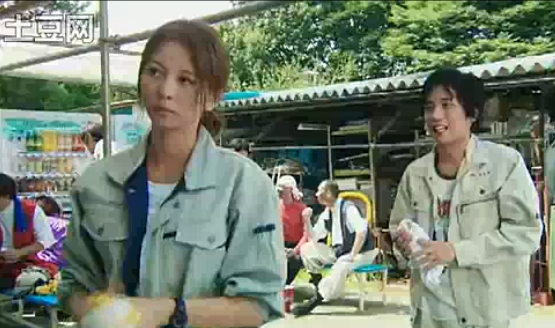
At work Seiji talks to the pretty girl who is stronger (Manami) than him about the job that they've been put on - the building of a new road. She tells him to tuck his pants into his boots and keep them that way.  She's the 安全管理 of the operation. Oh man, not everyone does construction work as a part-time job? Who knew?!


The road's completion date - the 納期 - is in two weeks, but they are hindered by a miscalculation in the 発注 of some necessary supplies. They have to leave work early  because work can't be continued until these supplies arrive. It's Manami's ミス; to make up for it, and for something to do, she mops the company floors. Seiji says her "I just want to do what I can do" attitude is nothing but self satisfaction. Meanwhile he talks to the boss about the abbreviated work schedule, wondering if he will get paid for the one hour he did work. His boss has no patience for him: 「金の心配するより やることあんじゃないか?」, he asks.  He tells him Seiji hasn't even worked an entire day, and leaves him after a "tch!" and a 「この半人前が!」


After work Seiji receives a call from his sister Ayako, who asks about his job (has he quit yet?) and about their mother (who the audience knows isn't doing very well). She wonders why he got a job doing construction of all things, and guesses it must be because Seiji is tired of being told things like 「食い扶持も稼げない!」 by their father. But Ayako isn't doing very well either. She's the 院長婦人of a hospital, not liked by her staff and pressured by the PTA of her son's school, who surround her like a pack of wolves and are obviously quite the gossipy bunch. One asks if she can prescribe her some high-blood pressure medication; Ayako explains that she can't do so without an examination. PTA lady #2 and #3 speak up, pressuring her to do something about it. PTA lady #1pressures her even further, saying,「 院長婦人なのに、お高くとまっていないからいいわよね」. In the end Ayako agrees, but angers her hospital staff by forcing them to take one patient, who came late, over the others, which will cause complaints.

 PTA's choice take-down maneuver: first they surround the victim like a pack of wolves...


Geez, the people in this family just can't catch a break. When Seiji comes home his mother (Sumiko) is worse. She compulsively sorts through the trash, which was returned because it wasn't properly 分別するed; there is a glass bottle in what should be only burnable garbage. The fact that she hasn't done this task properly, and 'caused problems for everyone', has a visible effect on her mind. There is no dinner and nothing in the fridge, but before Seiji can go out to get something his father Seiichi comes home. He takes one look at his wife, sorting through garbage on the dining room floor, and turns to escape up the stairs. Seiji angrily follows him and confronts him, saying 「見なかったふりしてんじゃねえよ!」 Seiichi says it's nothing abnormal and Seiji quickly accuses him of running away from his problems and not helping Sumiko.


Seichii turns the argument around and blames Sumiko's depression on Seiji, saying if anyone is running away it's him. Nothing is solved and in the morning Sumiko is still obsessively nervous about putting the trash out properly sorted, and when Seiji tries to calm her he ends up becoming late for a work. As a result his boss tells him to go home - he's messed up the dynamics of the day, which because of the delay yesterday is going to be one of hard work. It isn't the 人手の数, but establishing a positive team dynamic that is 重要 . Manami tries to cover for him, but it's no use. Seichi is sent home. Manami tells him to come tomorrow, but he doesn't see the point: it's a tiring and dirty job, and it's only good point is the fact that it pays well. "If you keep working here you'll see that it's about more than just the money," she tells him, but he leaves after saying he'll return the uniform when he washes it.


Seiji returns to the employment agency and says he will relax his standards for employment ( 「この現状から抜け出したいんで・・・」). He doesn't want to go as far as lowering the salary he wants, but the man behind the desk tells him it's necessary. It isn't Seiji who decides what he's worth, it's the company; and Seiji, who has 転々とdone his various part-time jobs over the past year, isn't worth what he thinks he is to companies.


What a blow. And to make it all worse, when he comes home he sees the trash has been returned once again. His mother rocks at the dinner table, apologizing to nobody (or everybody?). When Seiji tells her she doesn't have to apologize to anybody, it only makes her more disturbed. Seiji doesn't return to work, instead searching for jobs on the computer. That night he tries to talk to his father about employment. He had been angry when his father initially offered to try and hook him up with some jobs, but he says he's open to it now. It was an 大それたthing to say that he didn't have to rely on his father's influence. Seiji puts himself in a vulnerable position, but his father has no mercy. 「俺の頭に泥を塗るってワケか」 he asks. With Seiji's spotty track record, there is no doubt in his head that Seiji will quit again and embarrass him. Seiichi accuses his son of having always been a quitter, from swimming lessons to English classes. Seiji doesn't think that has anything to do with the current circumstances, but to Seiichi it's an 大有り. In Seiichi's opinion Seiji is always saying (言い張る) that the problem is that no one properly values him. But he needs to stop blaming other people; stop relying on other people; and most of all, 「俺に恥をかかせるな!」 This obviously hurts Seiji, who says aloud, after his father has left:  「どうせ俺は恥ずかしい息子よ。」


 It kind of looks like he's going to give him a fatherly pat on the shoulder. 
He's not.

Feeling sorry for himself, he apologizes to his mother Sumiko for not being employed. She is ironing is uniform. "But aren't you working? Doing construction," she says. Thanks to her, he decides to return to work and put in a hard day. When it comes to quitting time and some work still needs to be done to stay on schedule, he volunteers along with everyone else to stay behind. He calls his father to remind him to give Sumiko her depression medication; but Seiichi seems put-upon and angry like always. We see him withdraw a ton of money and disappear down the street with an unknown woman...

Soundtrack: Womanizer womanizer oh you're a womanizer.

On top of this, and just to make sure you weren't feeling better now that Seiji is still employed,  we get a glimpse of Ayako's mother-in-law, who is every bit as pressuring as the PTA ladies. "It looks like things aren't going well with the hospital staff," she says. "As the director you really should be able to get along with both the hospital staff and the PTA. But you know, the hospital won't ever really accept you, so at least get on with the地域のmothers." Ayako looks surprised at this piece of information and her mother-in-law smiles very passively-aggressively. Apparently, Ayako's marriage to Fumiya, her husband, was a result of a 妊娠; as such,  she'll never be accepted by the long-time staff of the hospital where her husband works.

In case you didn't know, this is what a passive-aggressive smile looks like.

Meanwhile, work on the road continues. Seiji is impressed by the way everyone 全力を尽くしているs. Back at home family life is still awkward - but at least he's having meals with the family. However, it seems like things will get even tougher - because there is someone sabotaging his mother's sanity by planting glass bottles in the plastic recyclables she puts out: the neighboring housewife!

  Exhibit A. Damning evidence, I say.

Seiji doesn't know this, though. At work they just barely manage to finish (納期ぎりぎり) after working through the night when a storm forces them to abandon their work during the day, and he is moved by the sight of 'their' road, and by his fellow workers' pride in their accomplishment.


Even so, when Manami tells him she'll see him tomorrow, he insists that he won't be there - he's still looking for better work, you know.

Seiji: Because I'm still better than construction work!
Manami: (-.-)'

And now some definitions for you. Not all of them were used above:
  • 最優先 
    • first priority
  • 作業前点検
    •  inspection before beginning operations
  • 怠る
    • to be negligent, to shirk
  • 安全管理 
    • safety control
  • めでたい 
    • auspicious, happy
  • 発注
    • placement of an order
  • 納期 
    • delivery date
  • 足引っ張る 
    • to stretch one's legs
  • 自己満 
    • self satisfaction
  • 「金の心配するより やることあん(あるん)じゃないか。」 
    • Don't you have anything better to do than worry about money?
  • 半人前 
    • half a man
  • 食い扶持 
    • board (as in room and board); food allowance; a living (食い扶持を稼ぐ)
  • 院長婦人
    • Director (female)
  • 高血圧の薬 
    • hypertension medicine
  • 分別する
    • separate (i.e. separate burnable garbage from recyclable garbage, etc)
  • 「見なかったふりしてんじゃねえよ!」
    • Don't pretend like you didn't see!
  • 人手の数 
    • The number of hands available
  • 重要
    • essential; important
  • 「この現状から抜け出したいんで・・・」 
    • I want to break out of this rut...
  • 転々 
    • moving around, here and there
  • 大それた 
    • appalling; outrageous
  • 「俺の顔に泥を塗るってワケか。」 
    • Are you trying to drag my name through the mud? Lit: Do you mean to smear mud on my face?
  • 大有り 
    • a big deal
  • 言い張る 
    • to insist; be obstinate in saying
  • 「俺に恥をかかせるな!」 
    • Don't shame/embarrass me!
  • 「どうせ俺は恥ずかしい息子よ。」 
    • I'm an embarrassment no matter what.
  • 地域 
    • neighborhood, area, region
  • 妊娠 
    • pregnancy
  • 納期ぎりぎり 
    • just barely delivered in time
  • 「全力を尽くしている」 
    • to exhaust all their strength

2011-02-08

Okinawa: Manzamo

 Another part of our delightful bus tour! I actually really wanted to see this, but others... Not so much. (Them: So what is it again? Me: It's a rock. A cliff. Shaped like an elephant. Them: ...And?) Well, sometimes that's enough! Geez! I mean, look at it!


IT TOTALLY LOOKS LIKE AN ELEPHANT!
Oh, the sea's really pretty too.

I have to say that while the view was AMAZING, it wasn't the kind of place that we could freely explore. I've heard something about tourists not being allowed on the cliff itself, but I can't specifically remember any signs. There was however, something like a designated walk-way. Our visit was fairly hit and run. There are some stalls set up in the parking lot; there is the cliff, which you can take pictures of; and you can walk around and take pictures of a bit more things. And then you go. No climbing, no hunting for cool never before seen areas... Maybe you could if you were not on a timed bus tour. It looks like a beautiful place for a nice picnic. Or a game of tag!

Provided you don't fall down one of these, of course.

The name, Manzamo, doesn't mean "This Cliff Totally Looks Like an Elephant, Check It Out", unfortunately. Apparently, in the late 18th century the Ryukyuan king Sho Kei visited the area, saw its grassy expanses, and said, "Man, 10,000 of my peeps could chill here!" only probably in much frillier language, as kings so often speak. So the name means something like "place where 10,000 men can sit".

King Sho Kei: I'm not even exaggerating, there's like, so much space!

Why would a king latch onto this comparatively mundane aspect in the face of the cliff's obvious elephant likeness? Actually it may not have been so obvious in the late 18th century. The cliff is made of limestone, which is very easily eroded away. All the more reason for you to stop by, especially if you have a leisurely picnic planned; it may be not so amazingly elephant-like for long. I suppose the area may not even be as big as it was when King Sho Kei first saw it. Nevertheless, it still is a beautiful place to see.


I was wondering about this picture below... What's the rope for?

2011-02-06

Okinawa: Ryukyu Mura


The other day I received an email from my host sister. They had gone to Okinawa and taken a picture in front of Shisa. Of course, I haven't told you readers much of Okinawa. So here is another installment, very belatedly. Welcome to Ryuukyuu Mura.

 
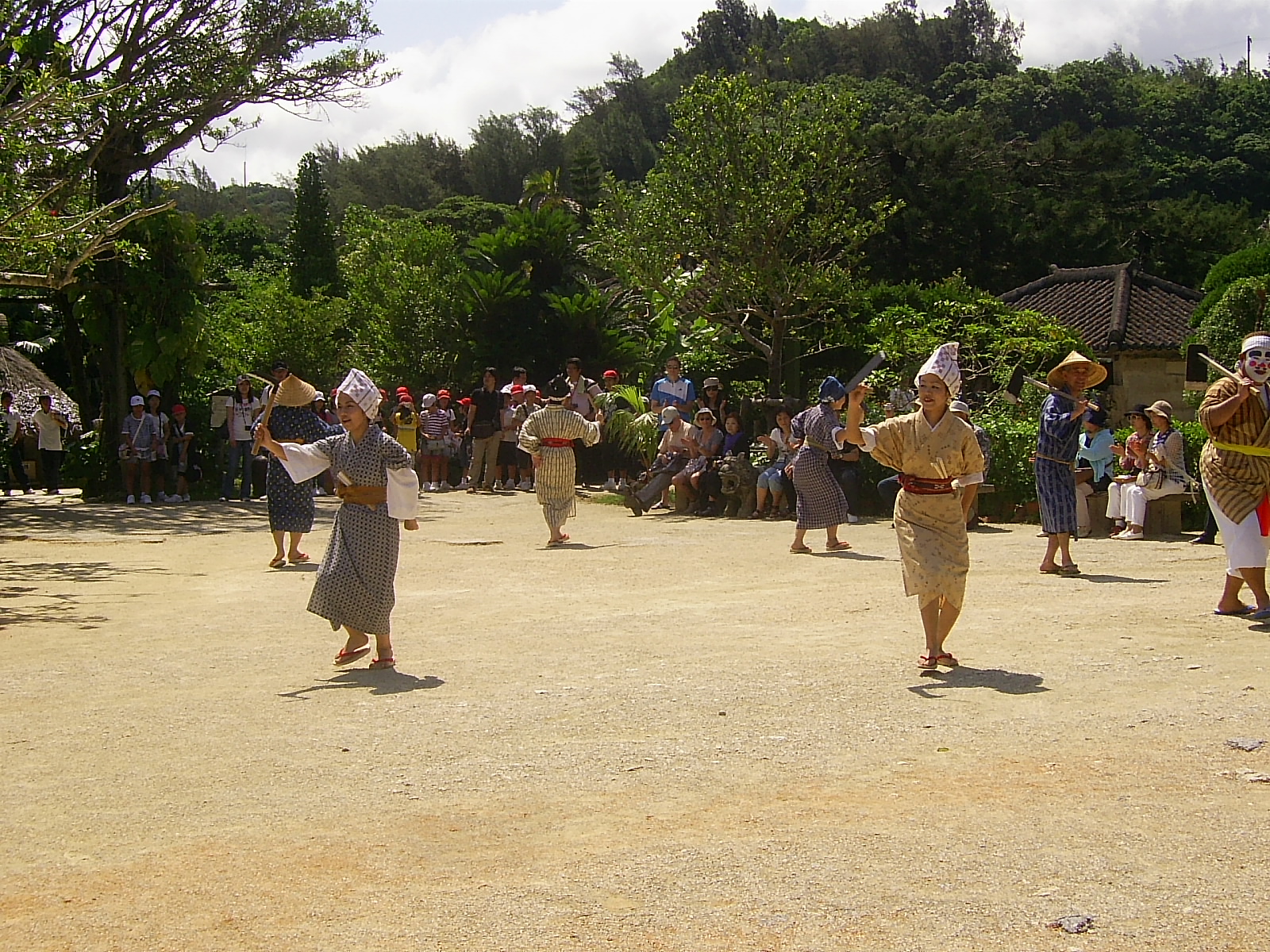
This was part of our bus tour. Ryukyu Mura is a park showcasing the culture and traditional homes and crafts of Okinawa, or the Ryukyu Islands. The Ryukyuan people are the indigenous people of Okinawa, who had their own kingdom prior to being brought under Japanese control. The kingdom was officially dissolved in the Meiji period, but had actively engaged in trade with China for a long period of time. They have their own language, which is related to Japanese, and a distinct culture. The homes in Ryukyu Mura were taken from throughout Okinawa and reassembled in the park, which offers musical shows and skits for the entertainment of guests, besides providing a cultural education.


There is also a snake show, featuring the Habu, which fights mongooses - not in the show, of course. Due to our time constraints, we were unable to see the show, but it plays on a schedule throughout the day. Incidentally, the habu, which is poisonous, gets put into sake.
 

 The little elves in the tree welcome you into the village.


There are displays of Ryukyu fashion, like above. Ryukyu Mura also showcases their clay-working skills (below). You can buy many clay trinkets and cups, etc, which are made on location. I bought a pretty turtle necklace for my aunt. 


You'll also be able to see dances (they encourage participation).


Martial arts demonstrations can be seen too, but we unfortunately missed them. We did, though, manage to catch a short skit:


Near the exit of the park, the brown sugar mill operates, still run by a water  buffalo, just as it was in the old days. The brown sugar is used to flavour many things, including the cookie-biscuits which are often seen in souvenir shops, said to have been the food stuff of kings.


There are little food shops, as well as souvenirs of all sorts. The food vendor that had this lovely fellow out in front of her window sold a delicious coconut drink, which Doro happily partook of. Mmm, coconut!


This is a must-go place, in my estimation. There is an ample variety of things to do and see - we did a lot of seeing, but guests are encouraged to try their hand at Okinawan crafts as well - and the area itself is quite beautiful, full of flowers and lush vegetation. It was a hot day but very cool in the shade of all the trees.

I will また来る!I will!

2011-02-05

Hello Again

Well, hello. Setsubun came and passed and I realized I hadn't written in a very long time. I guess I could say 「まあ色々があって・・・」 but that isn't really true. Anyway, I will be writing again.

Starting now! So, shadowing is this activity whereby you make your Japanese sound more natural. I did it religiously for a little while, then I stopped. Why? Partly because I just wasn't watching anything interesting enough. I found my interest caught instead by Korean dramas. Then I felt guiltier than I usually do for watching television, because at least when it's Japanese I can say that I am studying. Feeling the urge to once again delve into some shadowing/listening comprehension, I gave myself over to watching one of the dramas that recently came out: フリーター、家を買う。Or in a very very very free translation, Mr. Can't Keep a Job Buys a House. (That's what I call it, anyway.) It broadcast in Fall 2010 to good ratings.

 Hm, this photograph is very ominously torn.
Also, I think the father is Streseman from Nodame Cantabile.

It has a Johnny's Boy in it, if you're interested in that kind of thing. Actually, it's Arashi's Ninomiya, who acted in Letters from Iwo Jima. 


 I often don't feel like I'm well-versed enough in Japanese to accurately gauge if someone is doing a good job of acting in that language. Here Ninomiya strikes me as a good actor, but that may just be because it seems very un-exaggerated and naturalistic. Except the one scene at the end of episode one where he's crying in the mud. And it's raining on him..


Now that I've told you the end of the episode, I'll give you the event that's going to kick the whole series off. Ninomiya plays Seiji, who begins by saying: 俺の人生、いつもそこそこだった。He is getting into society now with a そこそこのjob and thinking he'll live a そこそこのlife, and like most soon-to-be/recent college graduates he's just thinking "What is the point of it all?" We see him at a company retreat in the first scene. Being beaten with a shinai.

 The truth about "real life" jobs, college seniors. 
You get hit. With sticks. 
I was unsure if I had actually heard "Michael Jackson". 
Then this happened. 

If I was made to act like Michael Jackson and crawl like a turtle for the sake of employee solidarity or something, I guess I would think "What is this shit?" too. Well, enough is enough and Seiji abruptly quits his job, thinking he'll be able to get another one. His father is completely pissed by the idea but his mother is very sweet and supportive. Seiji doesn't plan to be jobless for long but all of his applications are sent back to him. He goes to an employment agency, trying to get the job he wants, but eventually he has to lower his standards and get into part-time jobs, quitting those in rapid succession.

 Boss: I'd like you to be nicer to the customers.
Seiji: I QUIT.
Boss: D:

His father gets increasingly angry, and though his mother doesn't show it she's experiencing a lot of stress as well. Seiji becomes a shut-in to escape his father's rants (才能のない, etc). He sleeps late into the day, plays video games, and eats all of his meals in his messy room. Worse, he starts turning on his mother, who tries her best to pull him out of his depression.


Eventually his mother does smack him out of his funk... by having a mental breakdown. Seiji is there when it happens, technically. But he's up in his room playing video games. Naturally his father, and his older sister (who came in a panic to the house after hearing 38 messages of her mother repetitively saying ごめんなさい、今日もすみませんでした) are upset with him. The doctor recommends that Seiji and his older sister (Ayako) who has a household of her own, do their best create a happy environment and to make sure she takes her meds; she is in a very depressed. The stress of having a rude husband and a rude son will do that to a person, you know?  Since Seiji lives at home, and his Dad always works (and besides is always angrrrryyyy), it follows that he will have the most responsibility for his mother. Realizing this, Seiji resolves to get a job and contribute to the household. He gets a job at a construction site where a pretty girl is stronger than him.

I'm assuming this job and this girl will prove essential to reshaping his character/world view, and serve as the main thread of the story. Overall it's pretty interesting, but it seems like it will be the "Find yourself and your place in the world" kind of story. But, here are some words and phrases that you can learn from watching it:

そこそこ  alright, so-so

X才能ない don't have the capacity/ability/brains to do X

フリーター someone who works odd part-time jobs

ふるい落とす to be selective; sift out; screen candidates

書店バイト part-time work at a bookstore

「のんびりにしている」 being careless, lazing around

そもそも in the first place, to begin with, from the beginning

なさけなX pitiful X

先決 priority

就職活動 job search

「時間の無駄」 a waste of time

「再スタートできる」 "you can make a new start"

Since there a bit of mumbling, etc, it may be hard to make out a lot of things. There were some words I wrote down which I have no idea about. Try your hand at watching a show without subtitles and speaking along with it. Even if you don't catch everything, you'll find some benefit if you're shadowing at the same time. I'll write a bit about shadowing another day; this entry has become long enough!

2010-10-25

The Strange Young Man, Shinichi Hoshi

Here's the rest of the story. I was kind of disappointed by the end, but the more I think about it the more terrifying it seems to become. My only question is, why wait five years?

You can read the first half of the story here.

"The Strange Young Man", by Shinichi Hoshi, continued:


"Your name is...?"


"The name you had when you were alive doesn't mean anything once you're a ghost, does it?"

"Yes, you're quite right." The manager thought as he said this. The young man was certainly was a strange person. What he was saying and his way of speaking didn't seem flippant at all. So was he disturbed? If he was somehow made sane again, he'd clearly remember who he was, wouldn't he? The family could be informed, and the hospital could demand medical fees.


It was for the young man's own sake, too, and there was no doubt that the hospital's reputation would be improved as well. To start, a patient this strange was a first. He couldn't restrain his curiosity.

The manager took the young man with him to the neurologist, and informed him of the circumstances. The doctor also showed an interest, and began to question the young man again.


"So it seems that you're ghost..."

"Yea, I'm a ghost."

"I see, and about when did you become a ghost?"

"Five years ago."


"How did you become a ghost?"

"Doctor, don't you know that kind of thing? How people become ghosts?"

2010-10-11

Translating (a bit) on the Fly

Recently I've been looking for a short story to translate. I'm not sure I really have any criteria outside 'interesting', and I'm not that well-versed in Japanese authors outside the famous ones that have already been translated. The other day I went to the library and just picked out a few that seemed promising. The story I've settled on reading so far is called "Not Only Bread", by Meisei Gotou (「パンのみに非ず」、後藤明生). He's been translated into English ("Shot By Both Sides") before, but this collection isn't.

While his sentences don't seem terribly difficult, and there isn't a ridiculous amount of kanji for me to trip over, he does have some long sentences, kind of as if someone was talking to you or writing in stream of conscious, so I'm a little worried as to whether or not I can get the right tone. It's pretty humorous, as far as I can tell; it's the story of a guard at at a weight-loss center on the top of a mountain. I say weight-loss center, but the Japanese is 断食道場, which I suppose is literally 'fasting place'. Googling a bit it seems more like what we'd call a health and wellness center, or something, so that might be the better term, since I'm not sure if the people there have weight-loss in mind when they come to fast. I've only really translated the first page, and I'm not very happy with it. I'm going to read far ahead with as little dictionary interruption as possible, and then try to go at it again.

If you're looking for something Japanese to read, Shinichi Hoshi's stuff is fun. The sentences are straightforward, so I've been reading him in between other more difficult things; otherwise I run away to English books (or worse, the internet), and get no studying done at all. Here's a bit I did from おかしな青年. I translated it on the fly, so I'm sure there are things that aren't quite right, but I'll only put up enough to make you want to read it yourselves. Shinichi Hoshi does have a collection published in translation, so if you think you're reading skills aren't up to snuff, you may be able to find it in English (with a less clunky opening than my own).

***

"The Strange Young Man", Shinichi Hoshi

There was a large hospital. In this general hospital, with both internal medicine and surgical departments, there was also quite a substantial amount of medical examination equipment. The receptionist, wearing a troubled expression, came to the manager with some news.

Actually, there's a strange person here, and he won't leave.”

Is he sick?”


He doesn't look sick, but he must be.”


What's strange about him?”

He's mumbling nonsense.”


Now I'm interested. Lately all we've had is cut-and-dry cases. The consistency gets tedious. Let's have a look at him then. Bring him in.”


Yes...”


The woman returned with the young man, and had him sit in a chair. It's this person here.”


I see. Well then, please get on your with work...” The manager began to talk to the young man. Well then, what seems to be the trouble?”


2010-09-02

Japanese Games: Acchi Muite Poi あっち向いてポイ

"Hey, look over there!"

This is a game I played with my little host sister. I actually thought it was あっち見てポイ, but doing some searching I see that the 見て (look) is probably 向いて (turn; face), though I suppose in varying regions it may be different. Also, some people say ホイ instead of  ポイ.


Here's how to play:

1) Play Rock, Paper, Scissors. 


This is called Janken ジャンケン in Japanese. How you play the game (at what speed, with what hand movements, with what words) differs depending on where you are, so I would recommend just playing by your own rules.

The way that I learned to play in Japan is, you say 最初はグー、ジャンケンポイ!(First is rock, janken poi!), setting your hand at the ポイ. The rhythm of your hand movement seemed to be to down-stroke on every other syllable (which took me a while to get used to, since at my house we move our hand at every word and set our hand at scissors instead of 'shoot'). There is probably a different way of playing rock paper scissors for every 100 square miles of land on Earth.

Note: In the Japanese version I learned, if you tie you try to break the tie by saying あいこでしょ, setting your hand at でしょ. I'm not sure what aiko desho means; sometimes I hear it is used just to keep time. If you tie again, you keep on with the あいこでしょuntil a winner emerges.

2) Have you won?

If you've won the janken, you get to move on to the next half of the game. Point directly at your opponent's face. Your goal is to point in one of the four directions and have your opponent look in that direction, so try to keep your decision hidden (no shifty eyes!). Say あっち向いてポイin a measured way (to keep time), and at the ポイ you must point your finger in the chosen direction. My brothers don't speak Japanese and couldn't remember the phrase, so we just say "Look over there", 'there' functioning like ポイ. At the same moment, your opponent (whose goal is to NOT look in the direction you point) will move his head to face in their chosen direction. If the direction you point and he looks is the same, you have won. If not, go back to step one.

3) Have you won again?

If you've won the あっち向いてポイ part, you get to bask in your own glory a moment before starting the next game; or you get to deal out a punishment to the loser. My host sister and I played without any ばつ of course, but if you want to add some consequences to your game, it only makes it more exciting. At Nanzan the common punishment was a flick to the forehead with the middle finger. This is the worst punishment of all. If you are the loser, the winner will put his hand over your face, pry back his middle finger like a catapult, and then release it to wreak havoc on your third eye. If this is too extreme, I recommend the good ol' two finger slap to the wrist, or maybe an indian rug burn. If you teach this version of the game to boys, you will have them occupied on long car rides the entire trip, no matter how far the destination is.

Here's a video of a J-Pop group doing some あっち向いてポイ. I chose this one because when they're determining who is going to play who, they do something called グーとパーで別れ (separate with rock or paper). What you do is, everyone stands in a circle and at the last syllable of 別れ you choose either rock or paper. Until the group is evenly split by rock and paper, you keep doing this. It's an easy way to make teams, similar to the 'odd and even' or 'dickey dickey donkey' type of counting games that we do in America when splitting up to play tag, etc.