Showing posts with label vocabulary. Show all posts

2011-06-20

A Grand Memory for Forgetting...

Forgetting kanji, that is. I knew some kanji when I went to Japan, but I came back knowing many more, most of which I promptly forgot upon returning to school. I can recognize the bulk of the kanji that I've learned in the past, but writing it is another matter. Sometimes I forget how to write words that I learned my first year of study. This seems to be a common problem for most learners (and native-speakers) of Japanese. Once I was complaining about not being able to remember how to write something, and I was told "It's OK, Japanese people forget that kanji too."

While I have to admit that did, in some perverse way, raise my self-confidence, that kind of rationalization ultimately is of no use to anyone. Especially if that someone is studying for the JLPT - Japanese Language Placement Test. Yes, I am currently trying to bring my kanji knowledge (and my grammar) up to par for the JLPT. The first test is coming up in July, but I am signing up for the one in December. This gives me about 4 months to double the number of kanji I can read, learn some (mostly literary) grammar forms, and extensify my vocabulary (which is apparently small enough even in English that I feel the need to create words such as 'extensify').

There are many sites available for the purpose of studying kanji, but I've been using one called JLPT Kanji Project, which has flashcards separated by JLPT level. The design is easy to use and easy on the eyes. If you sign up for an account, you can put kanji you don't recognize or that you'd like to study further into a separate folder (up to 250 at a time). They also have a vocabulary section - in fact, when you click on a kanji to see its meaning and pronunciation, the description also includes relevant vocabulary, ordered by JLPT level. For example, the description for the kanji has a breakdown of its meaning (warship), pronunciation (かん), and the Level 1 vocabulary in which it appears: 軍艦.


Hopefully I can get my kanji knowledge up to the standard 2,000 or so. Once that struggle is over, the struggle to maintain it begins.

2011-06-15

Play some guitar and learn some Japanese

I took up guitar a month ago, thanks to a guitar-happy friend. Originally my goal was to play "Home" by Edward Sharpe and the Magnetic Zeros, which I had become obsessed with, and which, having only a few chords, seemed conquerable. Well, I still can't play B minor with any competency, unfortunately. But I am now able to play one of my favorite Japanese songs: チェインギャング (Chain Gang) by ザ・ブルー・ハーツ (The Blue Hearts).


I got the lyrics and the chords for Chain Gang at a site called Gakki , which also sells instruments (as you can probably tell by its name). It only has three chords, so it isn't the most complicated song, but I am practicing my Japanese, and learning new words. Once you translate the song, you basically have a sure-fire way to remember new vocabulary and their definitions. Even if you aren't teaching yourself/playing guitar, learning songs is a good way to practice pronunciation (although you'll find some singers who distort their words) and expand your repertoire of words. Some of the songs I'm hoping to move onto, once I finally conquer finally get tired of trying to conquer B minor are:

Luna Sea's Fate, more because it is fun to sing than the guitar part:


The Blue Hearts' キスして欲しい


Jero's 海雪, even though I'll never be able to sing it:


B'z's Calling:


Aqua Timez's 虹:
 

 Do As Infinity 真実の詩, although it was the ending song for Inuyasha, which I hate with illogical passion:


 ELLEGARDEN's Marry Me, even though it isn't in Japanese at all:

2011-05-30

Violent Onsen Geisha 暴力温泉芸者

The other day I decided I wanted to try translating something, ended up on the Asashi Shimbun webpage, and decided to translate a review based solely on the title of the work being reviewed. I ended up doing 斉藤環's review of 中原昌也's autobiography, 死んでも何も残さない. Nakahara Masaya is a fairly popular guy, it seems. The review mentions one of his (many) projects, "Violent Onsen Geisha," which is referred to as a ノイズユニット. Noise unit? I didn't find a definition online, but looking through my handy dandy notebook Google search, I eventually decided I'd be probably mostly correct in thinking ノイズユニットmeant noise. And by noise I mean noise music. If you are more knowledgeable than me, have heard of noise music, and like it, you may find this blog interesting, if you haven't found it already. You won't find Nakahara's personal site, though, due to his apparent distrust of the internets.

Anyway, the nearest brush I've ever had with 'noise' is maybe The Mars Volta (yes, I like them, leave me alone!) and I don't think they'd really be considered noise even if they have long passages of what I would call noise. So I wondered what the nature of Nakahara's noise music was. Also the name is pretty awesome. There is an array of his music on youtube. A couple of the songs I've heard from the album "Nation of Rhythm Slaves" use found music, but you can find all kinds of genres, it seems, in noise.


There is also a music video!


Violent Onsen Geisha appears to be operating under the name Hair Stylistics, now. 


There were aspects of the review other than ノイズユニットthat I had some trouble translating, so I'll probably be looking a bit more at those later.

2011-02-09

「フリーター、家を買う」第2話

Onto the second episode of フリーター、家を買う! This time, the episode I watched had 字幕, subtitles in Japanese! Oh, what a gift!  It's really helpful when half the time people are mumbling and speaking in that fast, natural, careless way that we take for granted when speaking in our native languages. Anyway, this episode starts with a very awkward family breakfast. Seiji tells his father (Seiichi) that he's got a new part-time job, and that he'll be helping with living expenses when his paycheck comes in - he's also still looking for a full-time job, though, which is his  最優先. In the middle of his little speech Daddy Take gets up and leaves for work. Man.

 Seiji: I'm really trying to--
Dad: PEACE.
Seiji: D:

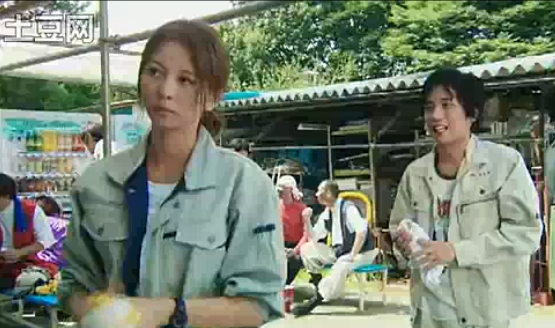
At work Seiji talks to the pretty girl who is stronger (Manami) than him about the job that they've been put on - the building of a new road. She tells him to tuck his pants into his boots and keep them that way.  She's the 安全管理 of the operation. Oh man, not everyone does construction work as a part-time job? Who knew?!


The road's completion date - the 納期 - is in two weeks, but they are hindered by a miscalculation in the 発注 of some necessary supplies. They have to leave work early  because work can't be continued until these supplies arrive. It's Manami's ミス; to make up for it, and for something to do, she mops the company floors. Seiji says her "I just want to do what I can do" attitude is nothing but self satisfaction. Meanwhile he talks to the boss about the abbreviated work schedule, wondering if he will get paid for the one hour he did work. His boss has no patience for him: 「金の心配するより やることあんじゃないか?」, he asks.  He tells him Seiji hasn't even worked an entire day, and leaves him after a "tch!" and a 「この半人前が!」


After work Seiji receives a call from his sister Ayako, who asks about his job (has he quit yet?) and about their mother (who the audience knows isn't doing very well). She wonders why he got a job doing construction of all things, and guesses it must be because Seiji is tired of being told things like 「食い扶持も稼げない!」 by their father. But Ayako isn't doing very well either. She's the 院長婦人of a hospital, not liked by her staff and pressured by the PTA of her son's school, who surround her like a pack of wolves and are obviously quite the gossipy bunch. One asks if she can prescribe her some high-blood pressure medication; Ayako explains that she can't do so without an examination. PTA lady #2 and #3 speak up, pressuring her to do something about it. PTA lady #1pressures her even further, saying,「 院長婦人なのに、お高くとまっていないからいいわよね」. In the end Ayako agrees, but angers her hospital staff by forcing them to take one patient, who came late, over the others, which will cause complaints.

 PTA's choice take-down maneuver: first they surround the victim like a pack of wolves...


Geez, the people in this family just can't catch a break. When Seiji comes home his mother (Sumiko) is worse. She compulsively sorts through the trash, which was returned because it wasn't properly 分別するed; there is a glass bottle in what should be only burnable garbage. The fact that she hasn't done this task properly, and 'caused problems for everyone', has a visible effect on her mind. There is no dinner and nothing in the fridge, but before Seiji can go out to get something his father Seiichi comes home. He takes one look at his wife, sorting through garbage on the dining room floor, and turns to escape up the stairs. Seiji angrily follows him and confronts him, saying 「見なかったふりしてんじゃねえよ!」 Seiichi says it's nothing abnormal and Seiji quickly accuses him of running away from his problems and not helping Sumiko.


Seichii turns the argument around and blames Sumiko's depression on Seiji, saying if anyone is running away it's him. Nothing is solved and in the morning Sumiko is still obsessively nervous about putting the trash out properly sorted, and when Seiji tries to calm her he ends up becoming late for a work. As a result his boss tells him to go home - he's messed up the dynamics of the day, which because of the delay yesterday is going to be one of hard work. It isn't the 人手の数, but establishing a positive team dynamic that is 重要 . Manami tries to cover for him, but it's no use. Seichi is sent home. Manami tells him to come tomorrow, but he doesn't see the point: it's a tiring and dirty job, and it's only good point is the fact that it pays well. "If you keep working here you'll see that it's about more than just the money," she tells him, but he leaves after saying he'll return the uniform when he washes it.


Seiji returns to the employment agency and says he will relax his standards for employment ( 「この現状から抜け出したいんで・・・」). He doesn't want to go as far as lowering the salary he wants, but the man behind the desk tells him it's necessary. It isn't Seiji who decides what he's worth, it's the company; and Seiji, who has 転々とdone his various part-time jobs over the past year, isn't worth what he thinks he is to companies.


What a blow. And to make it all worse, when he comes home he sees the trash has been returned once again. His mother rocks at the dinner table, apologizing to nobody (or everybody?). When Seiji tells her she doesn't have to apologize to anybody, it only makes her more disturbed. Seiji doesn't return to work, instead searching for jobs on the computer. That night he tries to talk to his father about employment. He had been angry when his father initially offered to try and hook him up with some jobs, but he says he's open to it now. It was an 大それたthing to say that he didn't have to rely on his father's influence. Seiji puts himself in a vulnerable position, but his father has no mercy. 「俺の頭に泥を塗るってワケか」 he asks. With Seiji's spotty track record, there is no doubt in his head that Seiji will quit again and embarrass him. Seiichi accuses his son of having always been a quitter, from swimming lessons to English classes. Seiji doesn't think that has anything to do with the current circumstances, but to Seiichi it's an 大有り. In Seiichi's opinion Seiji is always saying (言い張る) that the problem is that no one properly values him. But he needs to stop blaming other people; stop relying on other people; and most of all, 「俺に恥をかかせるな!」 This obviously hurts Seiji, who says aloud, after his father has left:  「どうせ俺は恥ずかしい息子よ。」


 It kind of looks like he's going to give him a fatherly pat on the shoulder. 
He's not.

Feeling sorry for himself, he apologizes to his mother Sumiko for not being employed. She is ironing is uniform. "But aren't you working? Doing construction," she says. Thanks to her, he decides to return to work and put in a hard day. When it comes to quitting time and some work still needs to be done to stay on schedule, he volunteers along with everyone else to stay behind. He calls his father to remind him to give Sumiko her depression medication; but Seiichi seems put-upon and angry like always. We see him withdraw a ton of money and disappear down the street with an unknown woman...

Soundtrack: Womanizer womanizer oh you're a womanizer.

On top of this, and just to make sure you weren't feeling better now that Seiji is still employed,  we get a glimpse of Ayako's mother-in-law, who is every bit as pressuring as the PTA ladies. "It looks like things aren't going well with the hospital staff," she says. "As the director you really should be able to get along with both the hospital staff and the PTA. But you know, the hospital won't ever really accept you, so at least get on with the地域のmothers." Ayako looks surprised at this piece of information and her mother-in-law smiles very passively-aggressively. Apparently, Ayako's marriage to Fumiya, her husband, was a result of a 妊娠; as such,  she'll never be accepted by the long-time staff of the hospital where her husband works.

In case you didn't know, this is what a passive-aggressive smile looks like.

Meanwhile, work on the road continues. Seiji is impressed by the way everyone 全力を尽くしているs. Back at home family life is still awkward - but at least he's having meals with the family. However, it seems like things will get even tougher - because there is someone sabotaging his mother's sanity by planting glass bottles in the plastic recyclables she puts out: the neighboring housewife!

  Exhibit A. Damning evidence, I say.

Seiji doesn't know this, though. At work they just barely manage to finish (納期ぎりぎり) after working through the night when a storm forces them to abandon their work during the day, and he is moved by the sight of 'their' road, and by his fellow workers' pride in their accomplishment.


Even so, when Manami tells him she'll see him tomorrow, he insists that he won't be there - he's still looking for better work, you know.

Seiji: Because I'm still better than construction work!
Manami: (-.-)'

And now some definitions for you. Not all of them were used above:
  • 最優先 
    • first priority
  • 作業前点検
    •  inspection before beginning operations
  • 怠る
    • to be negligent, to shirk
  • 安全管理 
    • safety control
  • めでたい 
    • auspicious, happy
  • 発注
    • placement of an order
  • 納期 
    • delivery date
  • 足引っ張る 
    • to stretch one's legs
  • 自己満 
    • self satisfaction
  • 「金の心配するより やることあん(あるん)じゃないか。」 
    • Don't you have anything better to do than worry about money?
  • 半人前 
    • half a man
  • 食い扶持 
    • board (as in room and board); food allowance; a living (食い扶持を稼ぐ)
  • 院長婦人
    • Director (female)
  • 高血圧の薬 
    • hypertension medicine
  • 分別する
    • separate (i.e. separate burnable garbage from recyclable garbage, etc)
  • 「見なかったふりしてんじゃねえよ!」
    • Don't pretend like you didn't see!
  • 人手の数 
    • The number of hands available
  • 重要
    • essential; important
  • 「この現状から抜け出したいんで・・・」 
    • I want to break out of this rut...
  • 転々 
    • moving around, here and there
  • 大それた 
    • appalling; outrageous
  • 「俺の顔に泥を塗るってワケか。」 
    • Are you trying to drag my name through the mud? Lit: Do you mean to smear mud on my face?
  • 大有り 
    • a big deal
  • 言い張る 
    • to insist; be obstinate in saying
  • 「俺に恥をかかせるな!」 
    • Don't shame/embarrass me!
  • 「どうせ俺は恥ずかしい息子よ。」 
    • I'm an embarrassment no matter what.
  • 地域 
    • neighborhood, area, region
  • 妊娠 
    • pregnancy
  • 納期ぎりぎり 
    • just barely delivered in time
  • 「全力を尽くしている」 
    • to exhaust all their strength

2011-02-05

Hello Again

Well, hello. Setsubun came and passed and I realized I hadn't written in a very long time. I guess I could say 「まあ色々があって・・・」 but that isn't really true. Anyway, I will be writing again.

Starting now! So, shadowing is this activity whereby you make your Japanese sound more natural. I did it religiously for a little while, then I stopped. Why? Partly because I just wasn't watching anything interesting enough. I found my interest caught instead by Korean dramas. Then I felt guiltier than I usually do for watching television, because at least when it's Japanese I can say that I am studying. Feeling the urge to once again delve into some shadowing/listening comprehension, I gave myself over to watching one of the dramas that recently came out: フリーター、家を買う。Or in a very very very free translation, Mr. Can't Keep a Job Buys a House. (That's what I call it, anyway.) It broadcast in Fall 2010 to good ratings.

 Hm, this photograph is very ominously torn.
Also, I think the father is Streseman from Nodame Cantabile.

It has a Johnny's Boy in it, if you're interested in that kind of thing. Actually, it's Arashi's Ninomiya, who acted in Letters from Iwo Jima. 


 I often don't feel like I'm well-versed enough in Japanese to accurately gauge if someone is doing a good job of acting in that language. Here Ninomiya strikes me as a good actor, but that may just be because it seems very un-exaggerated and naturalistic. Except the one scene at the end of episode one where he's crying in the mud. And it's raining on him..


Now that I've told you the end of the episode, I'll give you the event that's going to kick the whole series off. Ninomiya plays Seiji, who begins by saying: 俺の人生、いつもそこそこだった。He is getting into society now with a そこそこのjob and thinking he'll live a そこそこのlife, and like most soon-to-be/recent college graduates he's just thinking "What is the point of it all?" We see him at a company retreat in the first scene. Being beaten with a shinai.

 The truth about "real life" jobs, college seniors. 
You get hit. With sticks. 
I was unsure if I had actually heard "Michael Jackson". 
Then this happened. 

If I was made to act like Michael Jackson and crawl like a turtle for the sake of employee solidarity or something, I guess I would think "What is this shit?" too. Well, enough is enough and Seiji abruptly quits his job, thinking he'll be able to get another one. His father is completely pissed by the idea but his mother is very sweet and supportive. Seiji doesn't plan to be jobless for long but all of his applications are sent back to him. He goes to an employment agency, trying to get the job he wants, but eventually he has to lower his standards and get into part-time jobs, quitting those in rapid succession.

 Boss: I'd like you to be nicer to the customers.
Seiji: I QUIT.
Boss: D:

His father gets increasingly angry, and though his mother doesn't show it she's experiencing a lot of stress as well. Seiji becomes a shut-in to escape his father's rants (才能のない, etc). He sleeps late into the day, plays video games, and eats all of his meals in his messy room. Worse, he starts turning on his mother, who tries her best to pull him out of his depression.


Eventually his mother does smack him out of his funk... by having a mental breakdown. Seiji is there when it happens, technically. But he's up in his room playing video games. Naturally his father, and his older sister (who came in a panic to the house after hearing 38 messages of her mother repetitively saying ごめんなさい、今日もすみませんでした) are upset with him. The doctor recommends that Seiji and his older sister (Ayako) who has a household of her own, do their best create a happy environment and to make sure she takes her meds; she is in a very depressed. The stress of having a rude husband and a rude son will do that to a person, you know?  Since Seiji lives at home, and his Dad always works (and besides is always angrrrryyyy), it follows that he will have the most responsibility for his mother. Realizing this, Seiji resolves to get a job and contribute to the household. He gets a job at a construction site where a pretty girl is stronger than him.

I'm assuming this job and this girl will prove essential to reshaping his character/world view, and serve as the main thread of the story. Overall it's pretty interesting, but it seems like it will be the "Find yourself and your place in the world" kind of story. But, here are some words and phrases that you can learn from watching it:

そこそこ  alright, so-so

X才能ない don't have the capacity/ability/brains to do X

フリーター someone who works odd part-time jobs

ふるい落とす to be selective; sift out; screen candidates

書店バイト part-time work at a bookstore

「のんびりにしている」 being careless, lazing around

そもそも in the first place, to begin with, from the beginning

なさけなX pitiful X

先決 priority

就職活動 job search

「時間の無駄」 a waste of time

「再スタートできる」 "you can make a new start"

Since there a bit of mumbling, etc, it may be hard to make out a lot of things. There were some words I wrote down which I have no idea about. Try your hand at watching a show without subtitles and speaking along with it. Even if you don't catch everything, you'll find some benefit if you're shadowing at the same time. I'll write a bit about shadowing another day; this entry has become long enough!

2010-08-11

Beautiful Words 美しい言葉

The other day I was looking around Language Hat (an interesting language blog that I recommend you check out) and happened onto one of its linked pages, Jeff Miller's Collection of Word Oddities and Trivia. There's a small collection of "Beautiful Words" there. Looking at the many words which, through one individual's preference or various surveys, had the honour of being called the English language's "Most Beautiful Word", I began to think about my own opinion. I wrote a bit about in at Lang-8 yesterday.

It was difficult to chose. There are so many words in the English language, and although I know only a fraction of them I still have quite a large selection to choose from. Add the unfortunate fact that one can't even call to mind half of that extensive vocabulary when one tries. Besides the problem of the English language's breadth, I started thinking about the problem of categorizing a word into the 'beautiful' category. Of course the definitive quality when considering a word's beauty would be the sound of that word, wouldn't it? To determine whether a word is beautiful could simply be deciding whether or not you find it euphonious. But I'm sure words are disqualified from being considered 'beautiful' by the connotations which they have. A word with an ugly meaning has a much smaller chance of being called 'beautiful,' even if the sounds of that word in isolation are pleasing to the ear. For native speakers, at least, I think meaning is what comes to mind before sound. I have to admit that I think "putrescence" is a lot of fun to say, and maybe even that it has an almost elegant sound, but unfortunately its meaning ruins the package.

After a lot of hemming and hawing I thought I would chose "evanescence" (it's obvious I like "-scence" sounds, isn't it). I think the open vowels and the soothing, hum-like quality of its consonants contributes to an overall beautiful sound; it's easy on the tongue. It isn't quite melodious, though. I don't know if I always find individual words melodious, but I do often find various sentences, combinations, or phrases to be melodious. Perhaps it has something to do with length.

Today I found an article about 'beautiful words' in the New York Times which is an interesting read. Reading about the Italian who agreed that "cellar-door" is the "the most beautiful combination of English sounds" in the language, I recalled my own thoughts about what I found to be the most "beautiful combination" of Japanese sounds:

「ドアが閉まります」 or in hiragana - どあ が しまります; or in romaji - doa ga shimarimasu.

This means "The door is closing", and is usually followed by 「ご注意ください」, "please be careful", or "caution". You hear it about every day... Anywhere there is a closing door. Naturally to native Japanese speakers this is entertaining, because the the meaning is so ordinary I doubt anyone gives this combination of words a second thought. But I find it melodious.

I asked some Japanese readers what they thought (their answers - and many corrections to my post - are on Lang-8 of course). I found all of their answers to be euphonious in my own opinion too. One phrase which I hadn't thought about, but which I do think sounds quiet melodious, was tomochanさん‘s suggestion: "without saying goodbye". The words seem to flow into one another. (Perhaps the 'wistfulness' of the phrase also contributes to its euphony, though...?)

As a foreign speaker of a language, which words of that language do you think sound beautiful? Elegant? Funny?  What about in your own language? I think this is the kind of opinion that will change often. There are so many words to think of!

Today, for example, I have decided I quite enjoy the word "lament" or "licorice". And a very melodious Japanese word would be マックドナルド (McDonald's).

2010-07-12

Vocabulary of the Week: Unubore うぬぼれ

 The word this week is うぬぼれ, conceited or pretentious. I wonder if you can stick さん on the end, like you do with forgetful/scatter-brained (うっかりさん)...

So after my morning run I decide to brush up on some Japanese as I nosh on my oatmeal. Whilst browsing I came across the first episode of Unubore Deka うぬぼれ刑事 (Detective Conceited). (刑事 is really read "keiji", but I've heard it being called "Deka"). Starring Nagase Tomoya, and with Ikuta Toma and tons of other high profilers, it is apparently one of Japan's new summer dramas. You can see a bit about it here.

Well, it sounds interesting. Nagase is a detective who is obsessed with finding love, it seems, but unfortunately the girls he meets are all criminals. He watches videos by a man who talks about "feeling glances", and gives advice on just how long to hold one of these glances, and when to turn for the double take, etc. In the opening scene he is trying out these techniques on a girl at the conbini. It seems to work, and they go out for coffee, but really it isn't because she's into him, though he assumes she is; it's just because she thought he'd caught her shoplifting. Funny, right?

The series seems really dialogue heavy. I'm keeping up well with the story and the characters, but I know that there is tons of jokes, etc, that I'm missing all the same. The man that plays Nagase's father -- it was so hard for me to understand him sometimes, he spoke so quickly. But I enjoyed the series none the less, and caught some grammar points that I had learned. Plus this vocabulary, which you can use to insult the big-headed person in your life.

You can watch it here, if you aren't in Japan (TBS doesn't allow other countries video access.) Happy 聞き取り!

2010-05-24

Vocabulary of the Week: Goodbye さらば

さらば is just an old-timey way of saying goodbye (like farewell). You can hear it in this song called "Sakura" by Moriyama Naotarou.


Soon I will be saying goodbye to Japan. It's going to be hard. I will miss my walk home from school. My host family. Pastries filled with bean paste. Rugby. Judou. My friends. Tea Ceremony class. The convenience of trains. The narrow roads and the hills. The neighbors. Wasabi with my steak. Miso soup. Working pedestrian lights. The frogs that sang incessantly outside of my window. Were they frogs?

I said goodbye to my friend the other day. She left for America the day before yesterday. I didn't cry until I walked by the bicycle park where we would meet up before she left to ride home and I walked up the hill to my house. I never thought I would cry looking at a bicycle park.

さらば、友よ。

さらば、日本。

2010-05-12

Vocabulary of the Week: 勤労学生・きんろうがくせい・A Student Who Pays Their Own Way Through College

Yes, I am an 勤労学生、working my way through college. I am blessed to go to a school that offers me a good deal of financial support, but others aren't so lucky. The first kanji is the same kanji you will see in 勤める・つとめる、to be employed, and 労 symbolizes effort. They may have to get 深夜勤・しんやきん graveyard shifts to make their work schedule fit with their school schedule. I have worked until 3 a couple nights and since then I have tried as hard as I can to never be on another night shift again.

I was wondering about the difference in college society for Japan and America. A lot of the people I know have part-time jobs, both in America and Japan. However, I heard that in Japan many people live with their parents through college. This may just be my own experience, but from what I see of American culture, kids usually go out on their own once in college, living in dorms and eventually getting their own places off campus. I live at home during the summer, but work to pay rent during the school year, when I'm back on the other side of the country, so I suppose I'm somewhere in the middle. What's your view of it?

2010-04-26

Vocabulary of the Week: You suck どへたくそ

To start, this isn't a word you want to say out loud as you look at your computer in the middle of a cafe in Japan or something. I guess you could say that Japan doesn't really have any swear words, just rude ways of saying words, but this is a rougher word, so be careful when using it, if you ever do. This came about because I asked my host father the other day what ド meant; he basically told me it's something I probably would never use. I saw it used on a television program, and while I recognized the word that came after it, I was unsure really what ド added. Apparently, it's to add emphasis in a manly way. You can only add it to certain words, but I'm not sure what the criteria are.

I've never been called へたくそ (not to my face, at least), but I have heard it. It happens to be one of the words you can add ド to. Lousy/unskilled/poor・下手・へた is an easily recognizable word - it's just the opposite of 上手・じょうず. If you want to say "really bad at", you can say へたくそ、くそ being equivalent to 'crap' (and other similar words). Now you are free to use this word to criticize rudely criticize music/musicians you don't like. Do you have really terrible soccer skills? You might be called へたくそ。


So if 下手 means you're poor at X, へたくそ might be comparable to you're really terrible at/ you suck at X, and どへたくそ could mean you have no f-ing chance at ever being good at X.

Here's a bit more about how you can use it. Japanese-reading practice!

2010-04-18

Vocabulary of the Week: 基本的・きほんてき・kihonteki

Basically.

I hear this at least twice every time  I go to rugby practice, and as sad as it seems, for a couple of weeks I had no idea what it meant. Every time I heard it I obsessed over what it might mean, and made a mental memo to look it up when I got home, or to ask someone after practice, but I am an うっかりする kind of person (more on that word another day), and of course that never happened. (Until one day it did, and that's how I'm able to give you the definition of the word.)

 Kihonteki (基本的)means basic, as in "basic human rights" or "the fundamentals". 

There's something ironic in not knowing the word for basic.

2010-04-02

Vocabulary of the Week: まし・マシ・mashi

This is a hard one to say in a simple word, so first I will ask you the following. Do you remember those games you played in the elementary school cafeteria?

`If you were stuck on an island with one person, who would it be? The bride of Chucky or the kid who eats his boogers in class 2B?`

`If you had to choose how to die, would you die by having a bear eat your face, or by being lowered into a tank full of fire ants?`

If you were a Japanese kid, you might call these questions マシ (mashi). Basically, you use it when you are forced to make a choice by comparing things, usually distasteful things. So, if the kid across from you tells you he dares you to lick his shoe, and you wanted to say `I`d rather die`, you might say 「死んだほうがマシ・しんだほうがまし」.

If someone uses `mashi`  to ask a question, it seems to imply something like `All of the alternatives are bad, but which is comparatively least bad?` If you use it to answer a question, you`re implying something like `Well, both of those suck, but if I really have to choose I guess the least suck-tastic is this option.` There kanji for it is 増し, but I always saw it in katakana as マシ.

I came across this word several times while reading the Japanese translation of the Korean novel 'The First Shop of Coffee Prince." Some people might recognize the name, since it was dramatized for television and is pretty popular still. It reads like a manga (the protagonist is mistaken for a boy/masquerades as one, and when a guy develops feelings for her, thinking she`s a guy, he thinks he`s gay, and of course all of this mistaken identity/identity crisis craziness begets quite a few laughs), so if you want to try reading something for entertainment value so you don`t feel bad when you can`t read half the kanji contained in the sentence, I`d recommend it. Maybe I`ll translate some bits as practice.

2010-03-11

Vocabulary of the Week: to Pester・とねだる

I wish I could remember where I heard this word. Unfortunately, I just have the word written down and the definition (and under that, a game of まるばつ aka Tic Tac To, which I played with my host sister. Not sure if they have any connection...)

This will come in handy if you want to relate a story about being pestered. You can say something like:

お金を貸してとねだった・おかねをかしてとねだった He kept bugging me to lend him money.

部屋をそうじしてとねだる母・へやをそうじしてとねだるはは A mother who nags you to clean your room.

あのこっていつもこっちみてとねだっている That kid is always pestering me to look over at him.

This format is basically "Direct quote" quotative marker verb, so it's an easy one to use and remember! Being pestered isn't too fun, though, so hopefully you won't have too much occasion to use it.

2010-03-02

Vocabulary of the Week: Earthquake 地震・じしん


夕べ地震があったと聞いたんだけど、ぐうぐうと眠っていてぜんぜん気がつかなかった。
I heard there was an earthquake last night, but I was snoring away and didn't notice it at all. 

In Japanese, 地震・じしん is earthquake. The level of its strength by the Japanese scale is called 震度・しんど。 1 is the weakest, 7 is the largest. By the Japanese scale, I think the earthquake in Chile was categorized as a six.

This actually happened to me a few days after I came to live with my host family. My host father asked if I'd been woken up by the earthquake. No. I hadn't. This is not surprising, as even the fire alarm outside my bedroom apparently is not strong enough to wake me. I suppose I prefer dreamland. At the time I was a bit sad that I didn't get to experience the 'excitement' of my first earthquake, but after Chile I wonder if it isn't foolish to want to experience one.

2010-02-25

Vocabulary of the Week: Solitude・一人ぼっち・独りぼっち・ひとりぼっち

This is where you can play "Alone" by Heart, I guess.  Hitoribocchi means utterly alone, or solitary. The kanji is usually seen as 一人ぼっち、but can also be written 独りぼっち、and according to my dictionary, the kanji for hitori boushi (独法師) can also be read hitoribocchi.

I was watching a news program the other day, and they were talking about the meaning of hitoribocchi. According to the news program (I suppose I should say, "According to what I believe I understood the news program to say"), the phrase comes from hitori boushi (独法師)。The first kanji there is the same kanji that you will see in "independence." Anyway, 独法師 is basically an itinerant priest or monk. The monk would travel around by himself, sent out by his monastery or what have you, or  withdraw and wander around the world aimlessly and unaccompanied.

Try your hand at reading some Japanese by looking over the very brief explanation of hitoribocchi, and how the boushi of hitoriboushi became bocchi (or pocchi), by looking here.

2010-02-15

Vocabulary of the Week: Kokoro (こころ)

We're reading “Kokoro” (『こころ』) by Natsume Souseki in my Japanese Literature class. During the lecture our teacher told us a bit about the etymology of the word kokoro, heart.

First, there's an onomatopoeic origin. Koro koro (ころころ) is the sound that something makes, for example, when it's rolling quickly across the floor. Its sound is also reminiscent of the "lub-dub" of your heart's beat, don't you think?  It can also mean something that is easily overturned, or set into motion: for example, a conversation can suddenly, ころころと, turn to darker themes. I thought it was interesting that the sound, perhaps, of a heart could be related to the idea that it is something that is easily moved, or that  ころころと  changes.

The second word that our professor mentioned is the word kogoru (こごる、凝る), which means hard, frozen, or to coagulate. This seems to refer to the fact that the blood in your body hardens when your heart is no longer koro koro-ing. こごる can also signify a state in which you cannot break yourself free (ie, your arms and legs are bound). This brings to mind the way that your heart can be 'frozen' or 'captivated' by one thing. In fact that same kanji shows up in the word koru"(凝る), to be fanatic.

Thinking about the English "heart"... We use it in so many different phrases to signify so many different things. The center of something is the heart; you can believe something by 'taking it to heart'; someone with similar preferences to me is someone "after my own heart"; you can remember someone by keeping them "in your heart"; your emotions and opinions may be revealed if you "wear your heart on your sleeve"; a person who is too sympathetic is a "bleeding heart"; and so on. But I have trouble pondering the etymology of the word. It seems to stand on its own in my head. It isn't like the word inspiration, that you can break into Latin...

2010-02-01

Vocabulary of the Week: Bread's Ears (パンの耳)

Read in Japanese

I call the end of a loaf of bread the "heel” of the bread, but you also hear "butt of the bread" (that just sounds unappetizing) or simply the "end of the bread." Presumably they call it the heel because its hard and rough, just like the heel of a foot. I like this expression.

Apparently in Japanese, a load of bread does not have heels. It has ears! At first this sounded strange to me, but thinking about it, the ends of a loaf of bread are one on each side, just like your ears. Thus, pan no mimi パンの耳. In English the words that we use to signify those crusty slices of bread vary from person to person. I wonder if the same is true in Japanese? Maybe there's also a パンのおしり.

There's an old wives' tale that says if you eat the heel of the bread before eating the middle, you will never make ends meet in life. Imagine how many poor suckers there are in the world, whose only sin was to not like the crusts. (Does anyone remember the "Richie, eat your crusts" skit from Bill Nye?)


The real reason for eating the heel last is probably to keep the middle fresh, but whether the old wives' tale version is true or not I never eat the heel of a loaf bread without eating the slices in the middle first.


In my opinion bread ears are the tastiest part of the bread, especially if they are toasted.


単語 ・ パンの耳

英語で読む
この日記はYumieさん, truethさん、Miyokoさん、
Minoさん、Masamuneさんのおかげでもっといい文章になりました。
添削はこちらへ!

私はパンの硬い部分を「heel」と呼ぶんだけど、人によって「end of the bread」とか「butt of the bread」とか言います。でもパンのおしりって、全然おいしくなさそうですね。たぶんパンのその部分は足のかかとみたい硬くてざらざらしているから、そういうのかもしれませんね。「Heel」という表現が好きです。

日本でパンの「heel」ではなく、パンの耳だそうですよ。

初めて聞いたとき変だと思ったけど、ちょっと考えてみたら、パンの横にある硬い部分はまるで頭の横にある耳みたいですね。だからパンの耳ですよ。英語ではぱりぱりしたその部分は色々な名前があるか、日本でも同じなのかな。「The butt of the bread」のように、パンのおしりと言ったりするのかな?!

パンの耳を中央の部分より先に食べると、一緒やりくりできないという迷信があります。パンの耳が好きじゃないためにやりくりになった、かわいそうな人はこの世にいるのかな?(話が急に変わるけど、ビルナイという化学について、子供の番組で流れた「リッチー、パンの耳を食べなさい」という寸劇を、ご存知ですか?)


パンの耳を最後に食べる理由は、きっと中のパンをやわらかいままに保つためでしょう。でも迷信の言っていることは正しいかどうか、私は決してパンの耳を最初に食べたりはしませんよ!私の個人的な意見だけど、パンの耳はパンの一番おいしい部分だと思います。(特にトーストを食べるとき!)


Some points...

  • 表現 
    • 'expression' 
  • 言ったりする 
    • Past tense + り する. Do things such as... 
  • 中央の部分より先に
    • The middle part before... 
  • X理由はYため
    • The reason for X is Y 
  • 決してパンの耳を最初に食べたりはしません 
    • 'I will NEVER eat the heels of the bread first.' I think of the 'Xたりする' part as 'do the likes of..!'