2011-07-20

"Honto ni Honto ni Gokurousan" - Inugami Circus Dan


犬神サーカス団(Inugami Circus Dan, or the Circus Troupe of the Dog God) has been around for quite a while. Like, since 1872, according to their history. They are alive today because they were resurrected by alchemy in 1994 after a hundred year internment. You see, the 4-members of the band are siblings, children of a famous Noh actor of the Inugami family, which kept a crazed, hatred-filled dog's head with which to curse the unfortunate rival, etc. After a time they set out on their own, traveling around as an actor's troupe in Japan, when in 1894 they were buried alive by those who feared that the four had become possessed. After being resurrected in 1994, as I mentioned before, they began a rock-band, because  「もともとロックという表現形態は、怨念を娯楽化し魂の自由を獲得することを目的とした音楽である。それは迫害されて殺された四人の呪いを世間に放電するのに最適な手段であったのだ。」 That is, "(f)rom the beginning, the way of expression known as "rock" has been a kind of music which endeavours to change hatred to pleasure and gain freedom of the soul. It was the most suitable means by which the persecuted and executed four's curse could be discharged over the world."


If this back story doesn't intrigue you, what will? I've been listening to Inugami Circus Dan since high school, and for all of their dark or off-putting songs -- 「 皆殺しのララバイ」 or "Lullaby for a Massacre"  begins 体の中で骨が砕ける, the bones in my body are broken -- they have some fun (and funny) songs. These songs aren't completely devoid of the "this is kind of sad/gross/wrong) factor, but they get a giggle out of me. One of my favourites is ほんとにほんとにご苦労さん. The video is all one-take, and that's pretty impressive too. 


(It's been so bad for you, seriously, thanks for the trouble. It's been hard, let it out, seriously, thanks for the trouble.)


Don't you think it's unpleasant, Chief Clerk, sir?
You'll never ever be a popular guy
but all of your puns are dirty or about you
and the people that you talk to only manage a strained smile.
Truly truly thanks for all the trouble you went through.


Don't you think it's unpleasant, Section Chief, sir?
Although you never hear what people have to say
you'll muscle your way into a conversation
and the stories you tell are always about your manliness.
Truly truly thanks for all the trouble you went through.


(It's been so bad for you, seriously, thanks for the trouble. It's been hard, let it out, seriously, thanks for the trouble.)


Don't you think it's unpleasant, Department Head?
Always obsessing over work and work alone
you were tossed away by your wife and your kids
and now when you retire you will be living on your own.
Truly truly thanks for all the trouble you went through.


Don't you think it's unpleasant, coworker, sir?
When you are on your own you've really got no fight
but once you're in a crowd you get carried away
and you'll hurt someone and not even think of being contrite.
Truly truly thanks for all the trouble you went through.


(It's been so bad for you, seriously, thanks for the trouble. It's been hard, let it out, seriously, thanks for the trouble.)


Don't you think it's unpleasant, young President?
What necktie should you wear today? You can't decide.
At the bar you can't decide what drink you want to get.
You can't even decide how you should phrase your pick-up lines.
Truly truly thanks for all the trouble you went through.


Thanks for the trouble, thanks for the trouble, thanks for the trouble.
(もう沢山 かなり悲惨 マジ御苦労さん もう散々 要・発散 マジ御苦労さん)


いやじゃありませんか 係長
人気者でもあるまいに
ダジャレにシモネタ、自慢ネタ
取引相手も苦笑い
ほんとにほんとにほんとにほんとに御苦労さん


いやじゃありませんか 課長さん
ひとの話は聴かないクセに
突然 会話に割り込んで
語るよいつもの武勇伝
ほんとにほんとにほんとにほんとに御苦労さん


(もう沢山 かなり悲惨 マジ御苦労さん もう散々 要・発散 マジ御苦労さん)


いやじゃありませんか 部長さん
仕事仕事で気がつけば
女房子供に捨てられて
定年退職一人きり
ほんとにほんとにほんとにほんとに御苦労さん


いやじゃありませんか 同僚さん
独りだけでは弱いけど
大勢になったら調子こき
平気で誰かを傷つける
ほんとにほんとにほんとにほんとに御苦労さん


(もう沢山 かなり悲惨 マジ御苦労さん もう散々 要・発散 マジ御苦労さん)


いやじゃありませんか 若社長
今日のネクタイ決まらない
飲み屋で注文決まらない
くどき文句が決まらない
ほんとにほんとにほんとにほんとに御苦労さん


御苦労さん 御苦労さん 御苦労さん

Here's a bonus video of them playing Matsuda Seiko's pop hit, 夏の扉:


Oh, and they each have a blog.

2011-07-10

Grand Sumo Tournament in Nagoya: Takanoyama Shuntarou

The Grand Sumo Tournament began yesterday in Nagoya. It lasts until the 24th of July. That's a lot of Sumo for any enthusiasts in the Nagoya area. I wonder if my host father as tickets! If you happen to be there try visiting the official event site. Otherwise, you can see match results in English and watch it streaming (if you have WM11 installed) here.

Today the Asahi Shimbun's English edition had an article about a Czech-born wrestler who, after 10 years in Japan, finally moved to the second-highest level, 十両 juuryou,from the third ranking 幕下 makushita division in the wake of a bout-fixing scandal (八百長・やおちょう) that banned many of the top-ranking wrestlers from competition. Incidentally, did you know if you type 相撲 into Google, the third suggestion down is 相撲八百長?

Anyway, what I thought was interesting about the Czech sumou wrestler, whose wrestling name is Takanoyama Shuntarou, was his (comparatively) diminutive stature. And yet he can really hold his own, if this video is any indication. It's a pretty exciting bout.


 He doesn't do so well here, though.

You may say, "What about the fact that he's a foreigner doing sumou? Isn't that impressive?" I will say I was surprised when I first realized that foreigners did sumou - officially, and in Japan! But yes, foreigners also participate in sumou, and even reach the upper-most ranks. Asashouryuu, who I wrote about earlier, is from Mongolia, for example. Most seem to be from there; others are from places like Russia and Georgia, South Korea, China, even places further abroad such as Brazil and the United States. But I've never seen such a (relatively) tiny sumou wrestler before. I don't watch much sumou, but he's definitely rare for his size. Takanoyama is around 230 pounds, 160 pounds or so lighter than most wrestlers.  Of course size is not necessarily a determining factor - there was a sumou wrestler in the late 90's named Mainoumi who was lighter and smaller than Takanoyama (so small that he had silicone implanted in his head to meet the height requirement) and still made his way to the top. Check him out in action:


Takanoyama trains at Naruto Beya in Chiba, which has a 'diary' blog if you're interested in sumou and want to work on your reading skills!

2011-07-06

Part 3 of "Happiness Has the Form of a Kitten" (Otsuichi)

Part 1 Part 2


It happened the last week of June. That day it was clear all morning, with no sign of anything that might obstruct the sun. The rain started in the evening, so I ended up soaked on my walk home from school. Naturally, I had left the house without an umbrella, but I didn't even think of stopping on the way home to buy one. I wasn't carrying anything that couldn't get wet.

There was no one around the lake that I always passed by. Wooden benches were installed at regular intervals,  turned lonesomely toward the water. The opposite bank of the lake, blurred with rain, was foggy, and a haze hung between the water and the woods. There was no sign of life; the quiet sound of rain alone reigned over the lake and woods. My eyes were arrested by the unearthly scene, and I stood for a long while staring at the water. It was so cold the early summer seemed like a lie.


The quiet lake that spread before my eyes had stolen Murai's friend away. Its waters reflected an ash-colored sky. I was walking toward the lake as if being sucked in, but I didn't realize this until I was stopped by a thin fence.


The thought that Murai's friend might still be near this lake remained with me. They said his body had been removed. But he could still be there, like Yukimura, rising, sinking into the lake again and again. I thought it would be worth it to search the area more thoroughly. Even if he wasn't visible to human eyes, maybe the kitten would be able to find him. Murai needed to speak with his dead friend. That's what I thought. I had to come here with the kitten sometime.


I left the lake and began to walk home. When I got home, there might be a towel ready for me in the entryway. She could know that I'd be coming home soaked, and wait for me with dry clothes. Maybe she'd put out hot coffee to warm me up.


I felt an incomprehensible pain. I wondered how long this lifestyle could last. She would leave at some point. To that place where everyone goes eventually. Why didn't she leave now? Did she decide not to the moment she lost her life? Maybe she worried about the kitten she would leave behind.


The police said that the person who stabbed Yukimura was a robber. They still hadn't found the culprit.  Once in a while police officers would come to the house, talk, and leave. While it was  obvious she was loved by everyone, she didn't appear to have any close friends her age in the neighborhood. It couldn't be said that the crime was committed by someone she knew, just that she was attacked, unfortunately, by a robber who had come randomly to the house. It was a sad accident, equal to being struck by lightning and killed, or dying in an airplane crash.


In this world, there are many things that make you want to lose hope. Both Murai and I don't have the power to oppose that; all we can do is fall onto our knees and pray to God. We must wait for the sadness to pass over us with closed eyes and stopped ears, curled into ourselves.


What could I do for Yukimura?

2011-07-04

"Shima Uta" - The Boom


I fell in love with "Shima Uta" the first time I heard it. It had the Okinawan sound I had come to love in my short time in Okinawa and beautiful lyrics. The sugar cane lines? They get me every single time. I also love the traditional style of singing. I've been listening to it for a year or so now, but I hadn't realized that it was inspired by the plight of the Okinawan people during WWII, who hid in caves to escape American soldiers. The singer of The Boom, Kazufumi Miyazawa, wrote the song after hearing one Okinawan's tale of survival. Since its debut, it has been covered countless times by many singers, including a singer of the Okinawan dialect; a rock star trained in traditional 民謡(folk) singing; and an Argentian, whose version was on the top of the charts for a while despite being in Japanese. These versions follow the lyrics below.

でいごの花が咲き風を呼び嵐が来た
でいごが咲き乱れ風を呼び嵐が来た
くり返す悲しみは島渡る波のよう
ウージの森であなたと出会い
ウージの下で千代にさよなら


島唄よ風に乗り鳥とともに海を渡れ
島唄よ風に乗り届けておくれ私の涙


でいごの花も散りさざ波がゆれるだけ
ささやかな幸せはうたかたの波の花
ウージの森で歌った友よ
ウージの下で八千代の別れ


島唄よ風に乗り鳥とともに海を渡れ
島唄よ風に乗り届けておくれ私の愛を


海よ、宇宙よ、神よ、いのちよ、このまま永遠に夕凪を


島唄よ風に乗り鳥とともに海を渡れ
島唄よ風に乗り届けておくれ私の涙


島唄よ風に乗り鳥とともに海を渡れ
島唄よ風に乗り届けておくれ私の愛
The deigo flower bloomed and called the wind, and the storm has come
The deigo flowers blossomed and called the wind, and the storm has come
This recurring sadness is like the waves that cross the island
I met you in a field of sugar cane
Under the sugar cane, we say goodbye forever


Oh island song, ride upon the wind, and with the birds cross over the sea
Oh island song, ride upon the wind and carry off my tears


The deigo flowers fall, the ripples only tremble
This small happiness is fleeting, like flowers on the waves
You sang in the fields of sugar cane, my friend
Under the sugar cane, we part for eternity


Oh island song, ride upon the wind and with the birds cross the sea
Oh island song, ride upon the wind and carry off my love


Oh Ocean, oh Cosmos, oh God, oh Life, grant us the evening calm of this moment forever


Oh island song, ride upon the wind, and with the birds cross over the sea
Oh island song, ride upon the wind and carry off my tears


Oh island song, ride upon the wind and with the birds cross the sea
Oh island song, ride upon the wind and carry off my love


2011-06-28

"The World is Yours" - Buck-Tick

Buck-Tick has been one of my favourite bands for a while, just on the basis of a few songs that I've come across. I admire the range of styles, the guitar work, and especially the singer's (Atsushi Sakurai's) voice. Honestly, I could listen to his voice all day long. He doesn't limit himself to pretty singing though. Lately I've been trying to learn a bit more about their music. It's tough going, since they've been making music since 1983 (they made their major label debut in 1987) and put an album out every year.* They'll mark their 25th year anniversary in 2012 and have about a million* songs. *This is an exaggeration. They have 17th albums, not including mini/live/compilation albums, and at most half a million songs.

Today I've tried to translate "The World is Yours." It came out in 1990, in their 4th album 『悪の華』. They have a PV for this song, but something about the 80's/90's set, the fashion of the ladies in the audience (who are all standing like contestants in the Ms. America pageant for some reason), Sakurai's pants and the way they resemble a plastic bag, the gravity-defying spikes of hair that quiver above the drummer Yagami Toll, and the bit of monologue at the beginning of the performance (which provides more 聞き取り練習, hurrah), makes me want to place the video of their live on オールナイトフジ(All Night Fuji) here.

Now, without further ado, "The World is Yours."


I'll be scared and chewing poison, longing for destruction,
If I look for that fleeting dream at the apocalypse I was promised

Don't laugh baby, I've been looking foolish
I laugh and scream in the middle of the night
The shadow of megalomania dances
I'm bound so tightly it hurts on this moonlit night

I'll be drowning in the erotic and grotesque, a flower blooming out of season,
If I bleed red at the monochrome end

Don't cry baby, I'm run-down
I stop breathing in this languid darkness
And soar into this giant city's sky,
So drunk it's scary on this moonlit night

CRAZY NIGHT CRAZY MAN CRAZY MOON 
You are crazy
CRAZY LOVE CRAZY EYES CRAZY DREAM 
I'm crazy

Don't touch baby, this is goodbye
The night has swallowed everything
I'll burn out at the edge of this city
And never wake again

CRAZY NIGHT CRAZY MAN CRAZY MOON 
You are crazy
CRAZY LOVE CRAZY EYES CRAZY DREAM 
I'm crazy

Chewing poison, fleeting dreams, laughing, crying,
I'll bloom out of season, stop my breath and burn out
毒を咬み怯えてる 破滅へのあこがれ 
約束の終末に 淡い夢探せば 

 Don’t laugh Baby バカげてた……
笑い泣き叫ぶさ 夜の中
メガロマニアの影 踊りだす 月夜に痛い程縛られて…


エロ・グロに溺れてる 狂い咲く花びら 
モノクロの結末に赤い血を流せば 


 Don’t cry Baby ボロボロさ
息を止め物憂い闇の中
メトロポリス空に舞い上がる 月夜に怖い程酔いしれて

CRAZY NIGHT CRAZY MAN CRAZY MOON You are crazy
CRAZY LOVE CRAZY EYES CRAZY DREAM I’m crazy

Don’t touch Baby お別れさ
やがて夜は全て呑みこんで
メガロポリスの果て 燃え尽きる
月夜にもう二度と 目覚めない

CRAZY NIGHT CRAZY MAN CRAZY MOON You are crazy
CRAZY LOVE CRAZY EYES CRAZY DREAM I’m crazy

毒を咬み 淡い夢 泣き笑い 
狂い咲き 息を止め 燃え尽きる 

Regarding the lyrics: I made some vocabulary decisions about metropolis and megalopolis. They just seemed too big (or something, she said, poorly defending her decisions). I felt like metropolis could fit, but megalopolis? I realize megalopolis is not often heard in Japanese, either, but... I also wanted to separate from the verb tenses used in the original, but since I already changed it up a bit with the megalopolis/metropolis issue, I stuck to the Japanese. And last, there is no outright subject marked, so I suppose it could be someone other than "I" ("we" maybe? Or "you"?).  Really I went with what I felt was proper as I listened to the song, but it is something I pondered over. I'd be happy to hear your own thoughts on these matters, or any errors you notice/suggestions you have.

2011-06-27

『マルものおきて』Marumo's Rules Episode 1, Part 1

I'm trying to get more organized with my study, especially in terms of reading/listening, since I've been doing a lot of flashcards lately. So, I've made a rotation. I study about 1.5-2 hours of kanji, vocabulary, and grammar in the morning, and then sometime later in the day I'll add 1-1.5 hours of a listening/reading activity, or extra study. I'll rotate through the activities during the week. Reading includes stories and lyrics (lyrics I'll translate, stories I may not have time to); listening includes drama and podcasts, as well as shadowing (a summary/review of the drama, and a transcript of the podcast if it's short enough). This is my accountability feature. Let's see how long it goes! Since I only have one hour or so to watch, note, and review, I am splitting the dramas up into 20 minute segments. 

The first drama I'm looking at is: マルモのおきて . The ending theme song and dance are super cute and seem to be super popular to boot, judging from the youtube videos of people dancing to it in their living rooms.


I'm guessing there's a dog in this at some point. The title for this first episode gives it away: 独身男と双子が家族!? 犬がつなげた絆 (A single man and twins, a family!? A bond tied by a dog). Watching any commercial for the show also ruins what I guess would be a surprise (turns out the dog talks)  but in this first half of episode 1, the dog hasn't shown up. So far at this point the main characters are:
  • Mamoru 護 - the 担当 of a branch in a stationary (文具) company
  • Sasakura 笹倉- an old high school baseball buddy of Mamoru's, who suddenly returns for a reunion
  • Kaoru 薫 - Sasakura's young daughter, a twin
  • Tomoki 友樹 - Sasakura's young son, the other twin
I've seen the actor, Abe Sadao, who plays Mamoru before in the drama "OLNippon." I think he's good at switching between the comic and the serious, so I was excited to see him in this. I've also seen the actress for Kaoru before. Her name is Mana Ashida and she's referred to as a genius. Her acting skills are undeniably refined for someone her age. She's very believable and natural.

Anyway, finally onto the drama itself.

2011-06-25

Managers of the World Losing Face to a Fictional High School Girl: もしドラ

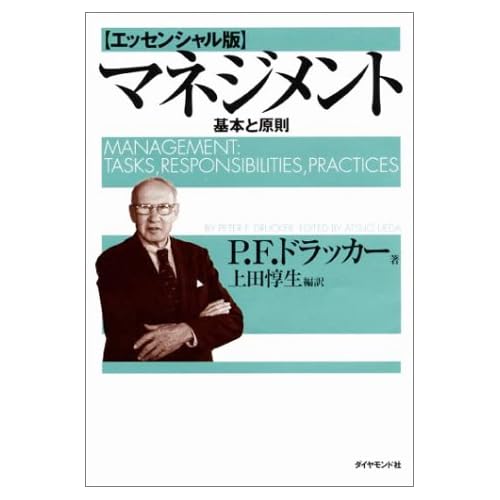
As promised in the last post here's the translation of  Naojirou Masaoka's article about the もしドラ novel by Natsumi Iwasaki. His article is titled 高校野球女子マネジャーにも劣る経営者たち (Managers Losing to a High School Baseball Club Manageress), and in it he talks about his recent perusal of the popular novel about a girl who becomes the manager of her high school baseball team and ends up picking up Drucker's book to educate herself about her new position. Masaoka didn't have a very high opinion of the novel in a literary sense, but he found that the protagonist Minami's approach to Drucker's complicated work, "Management," was worthy of a second-look. This is just a small excerpt from the first page, but he finishes his article with this line: 「世の経営者よ、「もしドラ」を読んでみようではないか。いや、P. F. ドラッカーの『マネジメント』そのものを「みなみ」のごとく熟読し、理解して実行に移してはどうだろう。」 (Managers of the world,  try reading "MoshiDora." Or rather, how about carefully reading, understanding and implementing P.F. Drucker's "Management"  as if you were Minami?)
Even if we discount the too-perfect aspects and the forced logic of the story, there are more than a few things that we can learn from this high school girl. However, in regards to the learning points which I point out here, and the evaluation of this increasingly popular novel, my opinions are completely different.
  1. The protagonist Minami Kawashima reads the part in which Drucker explains that "Mangers require only one quality, which is not ability, but earnestness" and ponders the meaning of "earnestness" until she comes to an answer. In this world, how many managers are there who have thought so thoroughly?
  2. When Minami is lost, she comes to believe that she must return to "Management." Again, how many managers have been so diligent as to return to their starting point, reflect on themselves, and try to find a solution?
  3. And, when give thought to the fact that we must fully interpret the content to put it into practice, the truth is that Drucker's book, "Management" is not necessarily easy to understand.
If we look at Drucker's assertions as a whole, we assume, as per his definition, that "management" is to guide the enterprise and decide its mission; in addition, to establish objectives,organize resources, and take responsibility for its success.

Drucker also raises three points for management duties.The first is to accomplish the objective and mission peculiar to the organization, the second is to work productively to bear results, and the third is to carry out social duties. Further, if a business' objectives are the creation of the client, Drucker offers marketing and innovation as the function by which those objectives can be achieved. We can define marketing as 'starting from the client' and innovation as 'bringing forth a new contentment.'

Incidentally, what is the relationship between function, objectives, goals, missions, and business guidelines? Or the relationship between the definition and function of management? The further we read the more difficult it becomes to understand the context of Drucker's assertion, and we are unable to grasp the technique necessary to put it all into effect. But Minami clearly explains the almost incomprehensible, nearly unimplementable contents of "Management," simplifies them to their barest, and beautifully puts them into effect. 

Let's compare the things which Minami explains and implements with the actual state of the world's managers...
Masamuneさん, like Minami and Masaoka Naojirou, believes Drucker's book is a good resource. Two pieces of advice, specifically, which Masamuneさん mentioned having read in "Management" made a good deal of sense, so I thought I'd share them here. These are paraphrases from my notes and from my conversation with Masamuneさん, not actual quotes from the book.

1. 資源と限界をわからないといかない。
Know your resources and your limits. 
2. 将来の成果のために、今日の計画を立てる。
Make a plan for today for the sake of your future success/results.

The second especially seems like an all-around good piece of advice. Like I said last post, I am a notorious 計画倒れ. Instead of making plans which always are set to start tomorrow, make them for today (to defeat the procrastination monster). If you're interested in more 名言 (wise sayings) from Drucker, try the following video. Japanese practice and more!